A Year of Enterprise AI Projects: What Actually Separates Success from Spaghetti-on-the-Wall
The questions our customers ask about AI have changed dramatically in 12 months. That shift tells us where enterprise AI is heading—and where it breaks.


Over the past year, we’ve helped organizations across manufacturing, distribution, technology, healthcare, and the public sector move from AI curiosity to AI maturity in production. In that time, we’ve noticed something more useful than any single project outcome: the questions themselves have gotten more ambitious, and more complex, at a remarkable pace.
A year ago, most customers wanted a chatbot. Today, they want autonomous agents coordinating work across their business. That’s not a gradual drift. It’s a steep climb up the complexity curve, and it changes what “getting AI right” requires.
The chart below represents the major use case themes our customers say they want to pursue using AI:
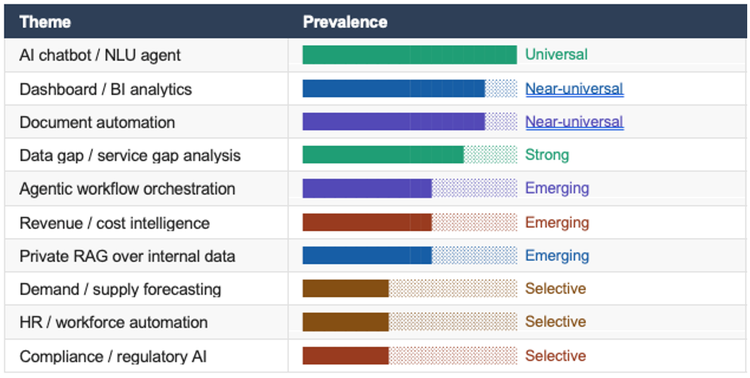
Figure 1.0: Use case themes
The pattern is unmistakable: demand is maturing from simple, single-source Q&A toward sophisticated, business-critical use cases. To make sense of the macro-level trends, we plot use cases on a capability map, measuring each one along two axes: the complexity of the data it draws on, and the degree of autonomous action it takes.
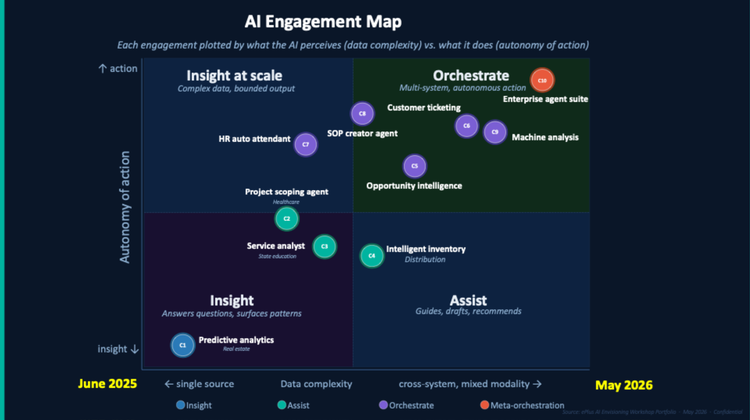
Figure 2.0: AI capability map
What the map reveals
Tracked across the past year of engagements, customer ambition moves in one direction, up and to the right:
- Twelve months ago, it was about starting simple. Most customers lived in the lower-left: chatbots answering straightforward questions from a single data source. A key focus was that most wanted to learn what insights AI can provide from existing data sets within the organization.
- Then, insight at scale. Customers moved up the curve, mining existing data, processes, and workflows for insights that weren’t previously accessible. Crucially, we learned these insights aren’t the destination. They’re the foundation that makes reliable agentic action possible.
- Now, agentic workflows. The focus has shifted to autonomous agents, digital coworkers that augment human teams and move the metrics leaders actually care about: revenue, cost, risk, and customer satisfaction.
- And the frontier: orchestration. As agents proliferate, a new problem emerges—coordinating them. Agents managing agents. This is early-stage work, but it’s the clearest emergent pattern in our data, and it’s the one most organizations aren’t ready for. It’s also where the real difficulty of enterprise AI now lives: not in any single model, but in orchestrating many of them safely and measurably. Keep that in mind as you read the five factors below, because as ambition climbs this curve, the cost of getting the fundamentals wrong climbs with it.
5 factors that separate the projects that ship from the ones that stall
- Start with a use case, not a science experiment
Throwing ideas at the wall to see what sticks is the most consistent way to waste an AI budget. Every engagement we run starts with an envisioning session built around a single goal: identify and scope the use cases worth pursuing.
Inside any organization, people sit at wildly different levels of AI fluency. Before scoping anything, we level-set on shared terminology, real possibilities, honest risks, and a common lens for evaluating what to build.
The most common failure: a team spins up an idea on a local tool with no defined ROI. If you can’t articulate what a use case is worth to the business, it won’t get funded into production, and it probably shouldn’t. - Put decision-makers in the room from day one
AI is not an IT project. It touches every part of the business, so every part of the business needs a seat at the table. Most importantly, the leaders who approve and fund use cases should be in the envisioning session themselves. When they see firsthand how you weigh value against effort, funding decisions get faster and buy-in comes built-in. - Get to a proof of concept fast, and be willing to kill it
The real value of a POC isn’t proving an idea works; it is cheaply proving which ideas don’t, before they consume a real budget. We’ve watched too many teams pour months into an idea that a two-week POC would have ruled out on day three.
Once you’ve narrowed your list, go straight to a POC. If it doesn’t validate your hypothesis, drop the use case without ceremony and move to the next. Cheap, fast, and unsentimental beats slow and hopeful every time. - Fix the data first, or don’t start
Every AI use case is only as good as the data beneath it. Clean, accurate, well-governed data isn’t a nice-to-have, it’s the precondition. If your organization isn’t prepared to do the unglamorous work of readying its data, pause the project there. No model overcomes a broken foundation, and the failures show up late, after you’ve already spent the money. - Coordinate everything. The model isn’t the hard part
This is the one that ties everything together. Remember the climb up the capability map, from chatbots to agents to orchestration? Every step up that curve raises the cost of a fragmented, uncoordinated approach. Handing every employee a license and hoping for the best isn’t a strategy; it’s a collection of disconnected experiments with no way to measure return. The organizations that win treat AI as a coordinated capability with shared standards, clear ownership, measurable value, and the orchestration layer to tie growing numbers of tools and agents together. That coordination is the hard part of enterprise AI. It’s also exactly where we spend our time.
These five factors are what we’ve seen consistently separate AI projects that reach production from those that quietly stall. There’s more we’ve learned, on governance, cost control, and building the orchestration layer itself, and we’ll get into it in upcoming posts.
If you’re ready to move from AI ideas to AI in production, the fastest place to start is an envisioning session, the same one we open every engagement with. Get in touch with us to learn more or check out our complete list of AI offerings at eplus.com/ai.
Related Topics
Share this article



